Five layers working together for better patient and client handling
The model combines platform intelligence, your business rules, agent instructions, live customer context and company learning into one conversation layer. The goal is simple: better answers, smoother handling and stronger booking outcomes without relying on a generic script.
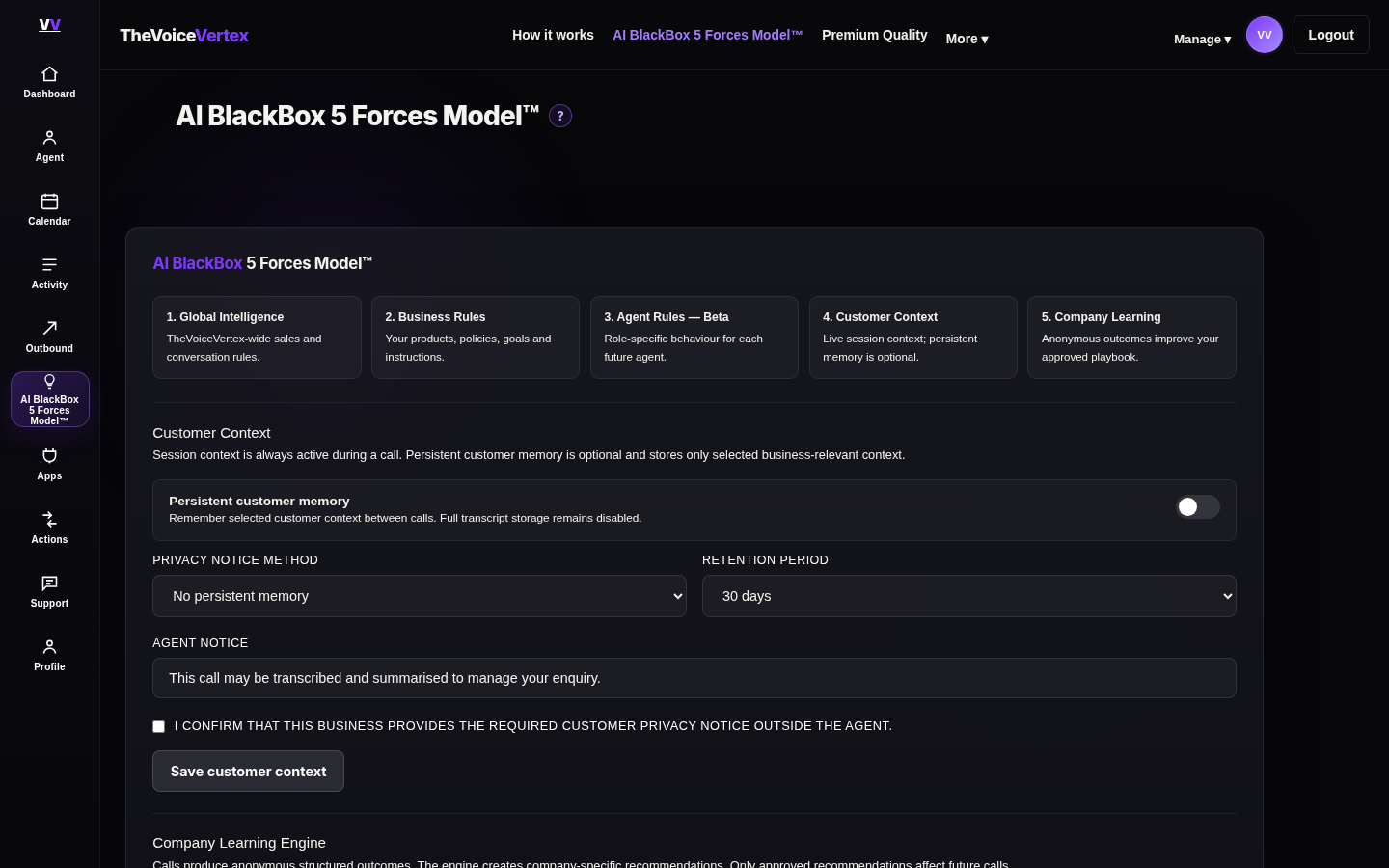
The 5 Forces
Global Intelligence
Conversation patterns and proven handling logic available across TheVoiceVertex AI. It gives the agent a strong baseline for qualification, objection handling, booking and support conversations.
Business Rules
Your policies, services, operating constraints, goals and booking requirements. The AI follows the rules of your business instead of improvising around them.
Agent Instructions
Role-specific behaviour, tone and objectives for the agent. This controls how the AI speaks, what it prioritises and how it moves a conversation toward the right next step.
Customer Context
Live conversation context plus selected persistent customer information when enabled. This helps the AI answer naturally without making the caller repeat relevant information.
Company Learning
Conversation outcomes can surface recommendations and operational findings. Approved improvements become part of the company playbook so handling can improve over time.
Not a generic receptionist script
The forces work together during calls and chat so the AI can answer questions, qualify people, follow business logic and move them toward booking or the correct next action.
The decision architecture behind every interaction
The AI BlackBox 5 Forces Model™ is the orchestration layer behind TheVoiceVertex AI. Instead of relying on one large prompt, each interaction is assembled from five separate intelligence layers so the agent can reason with the right business context while actions remain controlled and auditable.
Runtime context composition
Before the model decides what to say or do, TheVoiceVertex AI composes a focused runtime state from the relevant parts of all five forces. The model reasons over that state rather than treating every call as an isolated transcript.
The intelligence layer decides the next step. The execution layer validates and performs it. This separation lets the AI remain flexible in conversation while deterministic controls protect business rules and operational actions.
Structured working memory, not transcript replay
During a call, the system maintains a live working state for the facts that matter: caller identity, current intent, corrections, requested action, selected resource, appointment details and relevant prior context. When the caller corrects a fact, the current state can be updated instead of forcing the model to reinterpret the entire transcript from scratch.
Optional persistent customer memory extends that context across calls while keeping the business in control of what is retained.
Controlled company learning
Completed calls can be converted into structured outcomes such as booking success, unresolved objections, missing information, escalation patterns, follow-up effectiveness and recurring customer friction. Those outcomes are aggregated into company-specific recommendations.
Why this is more than an AI receptionist
Connecting a language model to telephony, a calendar and a prompt is reproducible. The harder layer is the orchestration around the model: runtime context composition, state management, business-rule enforcement, role-specific behaviour, tool execution, structured outcome extraction and an approval-based learning loop.
The base language model is therefore one component inside the architecture, not the architecture itself. It can be upgraded or replaced while the company-specific rules, context model, tool contracts and approved playbook remain intact.
Why the system becomes harder to replicate over time
The individual components are not impossible to copy in isolation. The defensibility comes from how they work together and from the private operational intelligence accumulated by each deployed business.
Two companies can use the same underlying foundation model and still develop very different behaviour because their business rules, customer patterns, call outcomes and approved improvements are different.
Technical summary
TheVoiceVertex AI is a real-time orchestration system in which a language model operates inside a layered decision architecture built from runtime context assembly, policy constraints, agent-level instructions, persistent customer state, tool execution, structured outcome extraction, recommendation generation and human-approved learning.
That combined architecture is what the AI BlackBox 5 Forces Model™ represents.
See how the rest of the platform connects to the model
Documentation covers Agent, Calendar, Activity, Outbound, Apps, Actions, Support and Profile.
Open Documentation